How Climate Change Impacts Life Under The Sea
Alarming Coral -ations
It doesn’t take much to bleach a coral reef. Water less than two degrees warmer for a few weeks too long, a smaller change than stepping out of the shade into the sun. And yet, beneath the surface, that small shift is unravelling ecosystems. While it may seem small to us, the reef remembers every degree.
Mapping the world's reefs
Coral reefs cover less than 1% of the ocean floor, but support over a quarter of all marine life. They house unmatched biodiversity and maintain the ecological balance of our oceans Here are the locations of the major coral reefs. Hover over to see reef names
Meet the Great Barrier Reef
Let’s focus on the Great Barrier Reef, the world’s largest coral reef system spanning over 1,400 miles of the coast of Queensland, Australia. It is the only living structure on Earth visible from space.
A Baseline Temperature
Here is the sea surface temperature of the Great Barrier Reef averaged from 2003 to 2007, acting as a baseline temperature. Sea surface temperature is the most fundamental factor that dictates coral health and fluctuations from this baseline can trigger stress or disease in coral. Hover over for specific temperatures. Yellow temperatures are hotter while purple are colder.
And Then, The Anomaly
The map now shows the change in sea surface temperature from 2003 to 2022. Natural climate cycles such as La Niña or El Niño cause some fluctuation, warmer in certain years and cooler in others, but the overall trend is clear. The water is warming. Drag the slider to explore changes over time, switching between sea surface temperature (SST) and anomaly with the baseline. Hotter anomalies are red and colder are blue.
The 2016 Great Barrier Reef Mass Bleaching
The 2016 mass bleaching event shattered historical precedents in scale and severity with only two widespread bleaching events before it. Primarily driven by a strong El Niño, the event killed an estimated 29 to 50% of shallow water corals. Let us look specifically at Cairns, known as the gateway to the Great Barrier Reef, which sits at the border of the Northern Section in which 99% of reefs experienced bleaching. Hover over each point to see every 8-day average sea surface temperature in 2016
A Line Corals Cannot Cross
Above the dashed line at 29.7ºC — a threshold of just 1ºC warmer than the historical summer average — corals begin to expel the algae inside them that provide up to 90% of their food. The skeleton turns a ghostly white. Still alive, but slowly starving.
Degree Heating Weeks: When Heat Accumulates
Bleaching itself is not always fatal, the accumulation of heat is what kills corals. Off Cairns in early 2016, the water held above the bleaching threshold for five consecutive 8-day periods, peaking at 30.6ºC. Degree Heating Weeks (DHW) measures this accumulated stress. 4 DHW indicates significant bleaching, while 8 DHW causes widespread coral death. Each 8-day period above the threshold pushes that count higher.
A Recurring Fever
However, the 2016 event was not a one-off. It happened again in 2022. This time, it occurred during a La Niña year, a climate phase that typically brings cooler conditions to Australia.
A New Pattern: From Rare to Routine
Before 2016, mass bleachings were rare enough to shock the world when they happened. Since then, the Great Barrier Reef has been bleached repeatedly, a pattern that is not only continuing, but accelerating. As the ocean warms further, the window for recovery from bleaching is closing quickly. Click to look at 2016 and 2022 separately or compare bleaching events
But coral doesn't only bleach when the warming crosses a line.
Sometimes the threat is not only how hot the water gets, but also how sharply the temperature fluctuates from one day to the next.
The Temperature Never Holds Still
Now, let us look at the day-by-day sea surface temperature for the Great Barrier Reef’s 2020 summer bleaching season. This first two-week window shows the fluctuating water temperature for each day. Hover over each point to see the sea surface temperature of any day
Corals Survive Within a Margin
Coral reefs are adapted not only to an environment with consistent average temperatures, but also a familiar band of temperature variation. The band for safe variation is 0.54ºC above or below the average temperature. While fluctuations within this range are ordinary, larger variations can cause bleaching due to thermal stress.
2020 Surpassed The Margin
Throughout the 2020 summer season, the true variation of daily temperature was over twice as wide as the safe variation margin. The variation lands far into the shaded regions, fluctuating at levels reefs aren’t able to absorb. Even when temperatures do not cross the bleaching threshold from before, this extensive variation builds up thermal stress on the reef.
Move Through The 2020 Season
Throughout the entire 2020 bleaching season, the variation within each two-week window never dropped into the region of safe variation. Drag the slider to move the window through the 2020 bleaching season in 2-week frames. Explore the daily temperatures or variation for every 2-week window.
Let's dive deeper.
Far below the surface lie reefs we once believed the heat could never reach.
The Reefs We Thought Were Safe
Between 30 to 150 meters below sea level, mesophotic reefs live in dimmer and cooler waters. These depths were once believed to be a refuge from ocean warming. Hover over to see projected sea surface temperatures for each year up to 2100 * Sea surface temperature is calculated as a 0.6ºC shift from surface air temperature
But Depth Was No Defense
Then came the 2016 Great Barrier Reef Mass Bleaching. During the bleaching, researchers documented that up to 40% of deep corals were bleached, dispelling the idea that mesophotic reefs were immune to warming. Further research placed the deep coral bleaching threshold at sea surface temperatures of 30ºC.
Nowhere To Hide
As temperatures are projected to keep climbing, they are expected to pass the threshold by 2075, leaving mesophotic corals vulnerable to widespread, inescapable bleaching.
More than just heat.
The ocean around a bleaching reef changes in other ways, leaving corals with even less room to survive.
2016: Effects of Heat Alone
In the 2016 bleaching event, sea surface temperatures were 3.3% above the 20-year average. Chlorophyll-a, representing water quality, and dissolved organics, representing water clarity, were both below average. The bleaching was purely due to heat without additional stressors. Click either box below for more information on the water quality indicators
What it is: A pigment produced by microscopic algae floating in the water. High concentrations signal an algae bloom.
Why it matters: Blooms cloud the water, blocking the sunlight corals need to feed. They also consume oxygen, adding stress to reefs already weakened by heat.
What it is: A measure of dissolved organic matter absorbing light in the water. The matter includes runoff, tannins, and decaying material.
Why it matters: High values mean murky water. Corals rely on light for energy. When clarity drops, they have fewer resources to cope.
2022: The Water Changed Too
By 2022, the water had shifted as well. Chlorophyll-a was 11% above average and dissolved organics were 8.1% above average. This means the corals were under broader water-quality stress alongside peaking temperatures. With changing ecosystem conditions, the effects of warming oceans is only exacerbated.
What it is: A pigment produced by microscopic algae floating in the water. High concentrations signal an algae bloom.
Why it matters: Blooms cloud the water, blocking the sunlight corals need to feed. They also consume oxygen, adding stress to reefs already weakened by heat.
What it is: A measure of dissolved organic matter absorbing light in the water. The matter includes runoff, tannins, and decaying material.
Why it matters: High values mean murky water. Corals rely on light for energy. When clarity drops, they have fewer resources to cope.
When reefs die, the loss ripples outward
A reef is never just a reef.
The Great Barrier Reef shelters over 9,000 known species and sustains communities thousands of miles away. When it bleaches, the damage rolls out on currents of empty nets, lifeless shallows, and battered beaches. Click a card to read more.
Food Scarcity
Click to readFood Scarcity
An estimated 500 million people directly depend on coral reefs for their daily food. Reefs are also essential for sustaining healthy fisheries which are the primary protein source for 3 billion people globally. Endangered reefs pose a threat to food security and can impact rates of childhood malnutrition and nutritional deficit.
Coastal Protection
Click to readCoastal Protection
Coral reefs absorb up to 97% of the energy from incoming waves and water near coastlines, providing a buffer that protects against wave action, storms and other environmental effects. For some low-lying islands and densely populated coasts, the reefs are the only defense against the open ocean.
Habitat Loss
Click to readHabitat Loss
Coral reefs are home to 25% of all marine life, meaning over 1 million species live in and depend upon coral reefs around the world. For these creatures, the reef provides essential food, shelter, and the spawning grounds needed for their species’ survival. When their homes disappear, survival rates plummet and marine biodiversity crashes.
Food Web Collapse
Click to readFood Web Collapse
Coral bleaching collapses the food web from the bottom up. Corals expel the algae that fuels them and the entire reef ecosystem. Animals that feed on that coral tissue starve, and as corals die, the structural collapse destroys the shelter for small fish, leaving them exposed to predators or forced to flee. With fewer small fish, larger predators go hungry and this loss ripples outward, reaching sharks, seabirds, and even humans.
A global pattern, not a place
Every Reef Remembers
What this story shows in the Great Barrier Reef — only needing a degree of warming, the threshold being crossed repeatedly, recovery time shrinking — is not unique to it. Reefs around the world are being bleached by the same warming water. The Great Barrier Reef is only one affected reef.
And heat is not the entire story. The deep reefs we once hoped could escape it are warming; day-to-day temperature differences decide which corals survive; and declining water quality narrows the margin further. Reefs are the ocean’s early warning system and the effects of their loss reach far beyond coral itself, into marine, and even human lives. What is unfolding in coral reefs is only a preview of how quickly warming oceans can unravel entire ecosystems, and of how little time is left.
The story continues. Below, you can explore warming in reefs across the globe.
Bleaching is a Global Story.
What About Other Major Reefs?
Start by hovering over for information on each major reef, including the time left to visit. Then, click to zoom to individual reefs and explore by dragging the year slider or switching between temperature and anomaly.
How Much Coral Has Bleached?
How much of the world's coral reefs do you think bleaching has impacted? Drag to bleach the reef, then submit your guess.
Source: International Coral Reef Initiative / NOAA Coral Reef Watch, April 2025
In Pictures and In Print
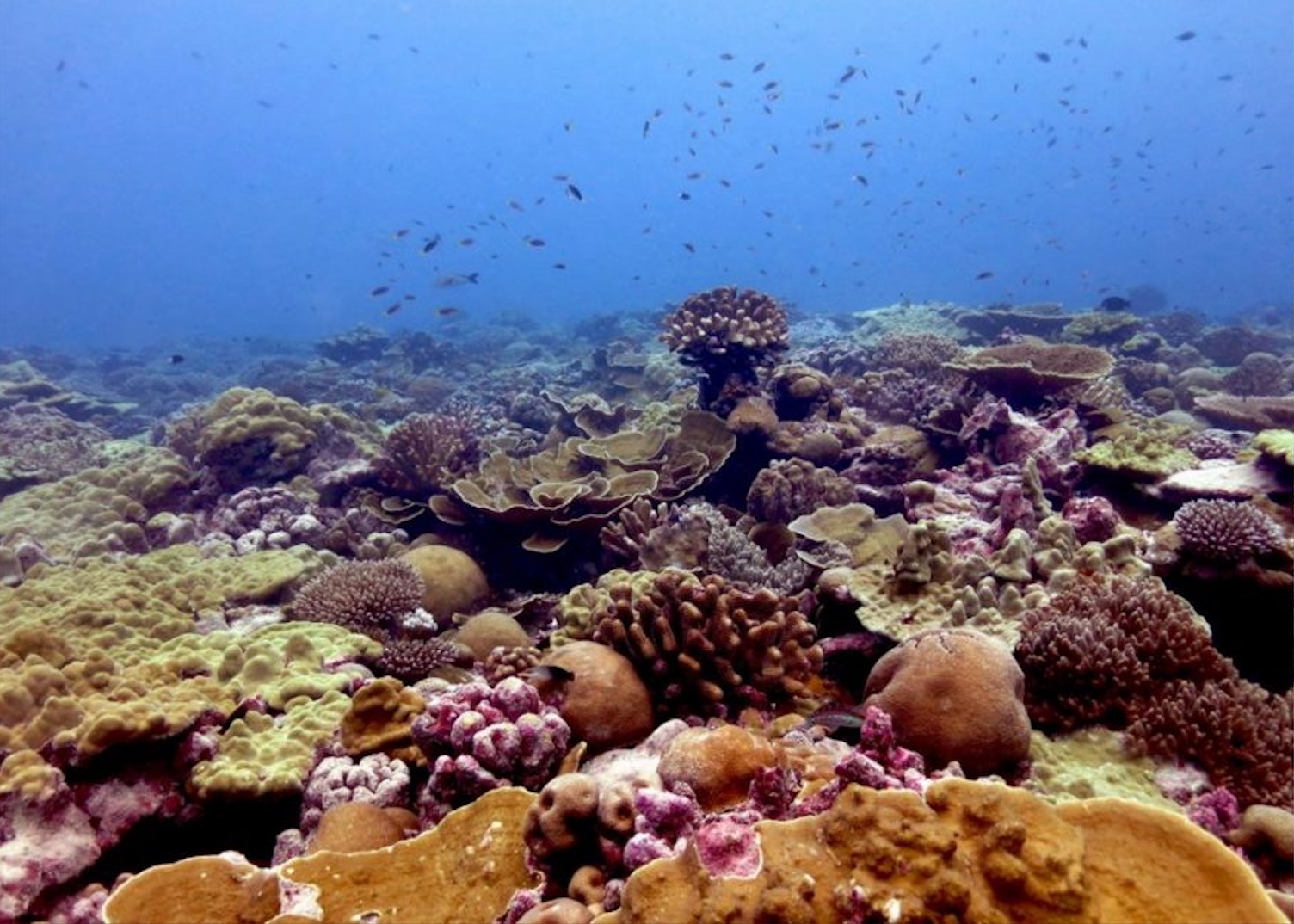
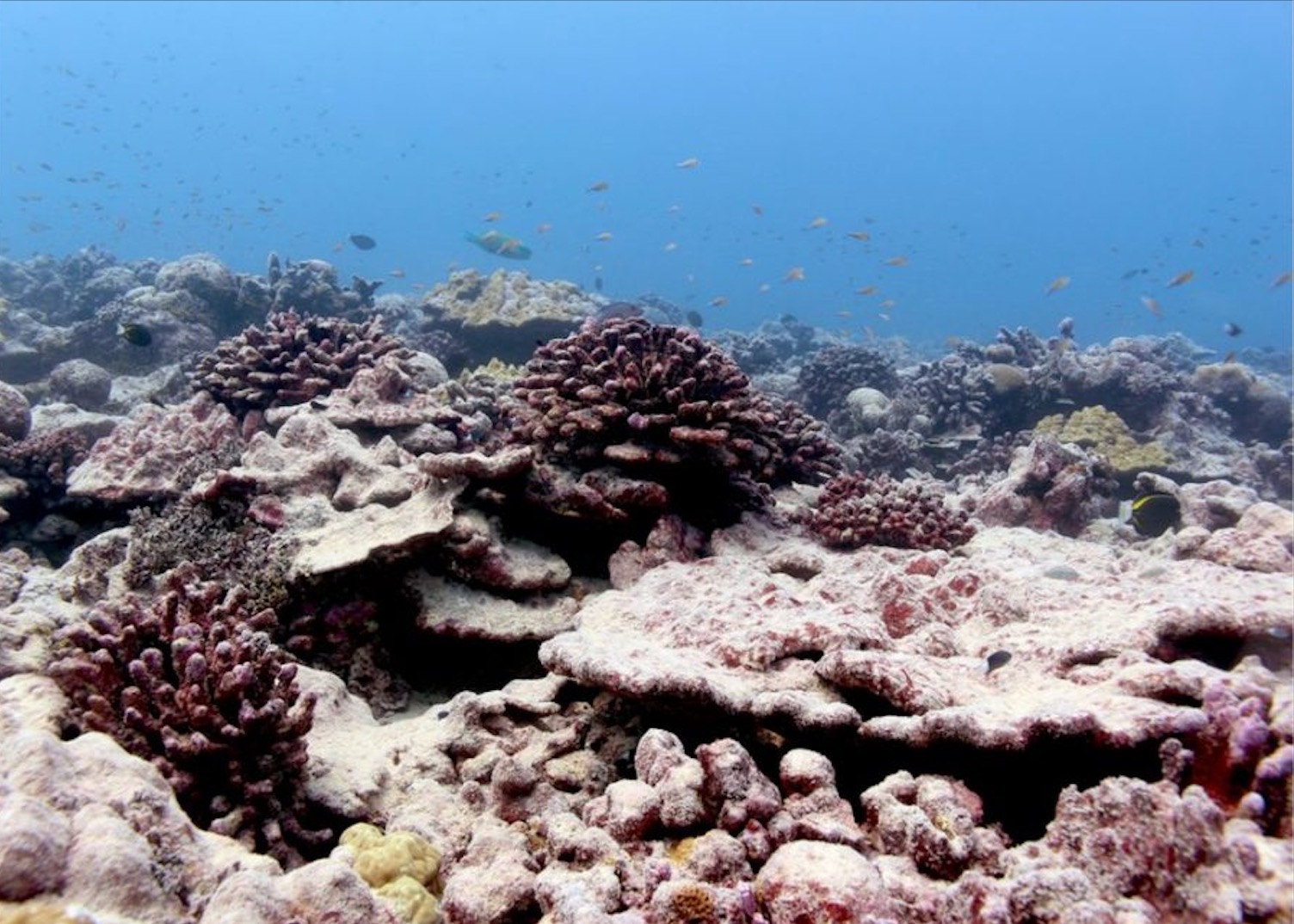
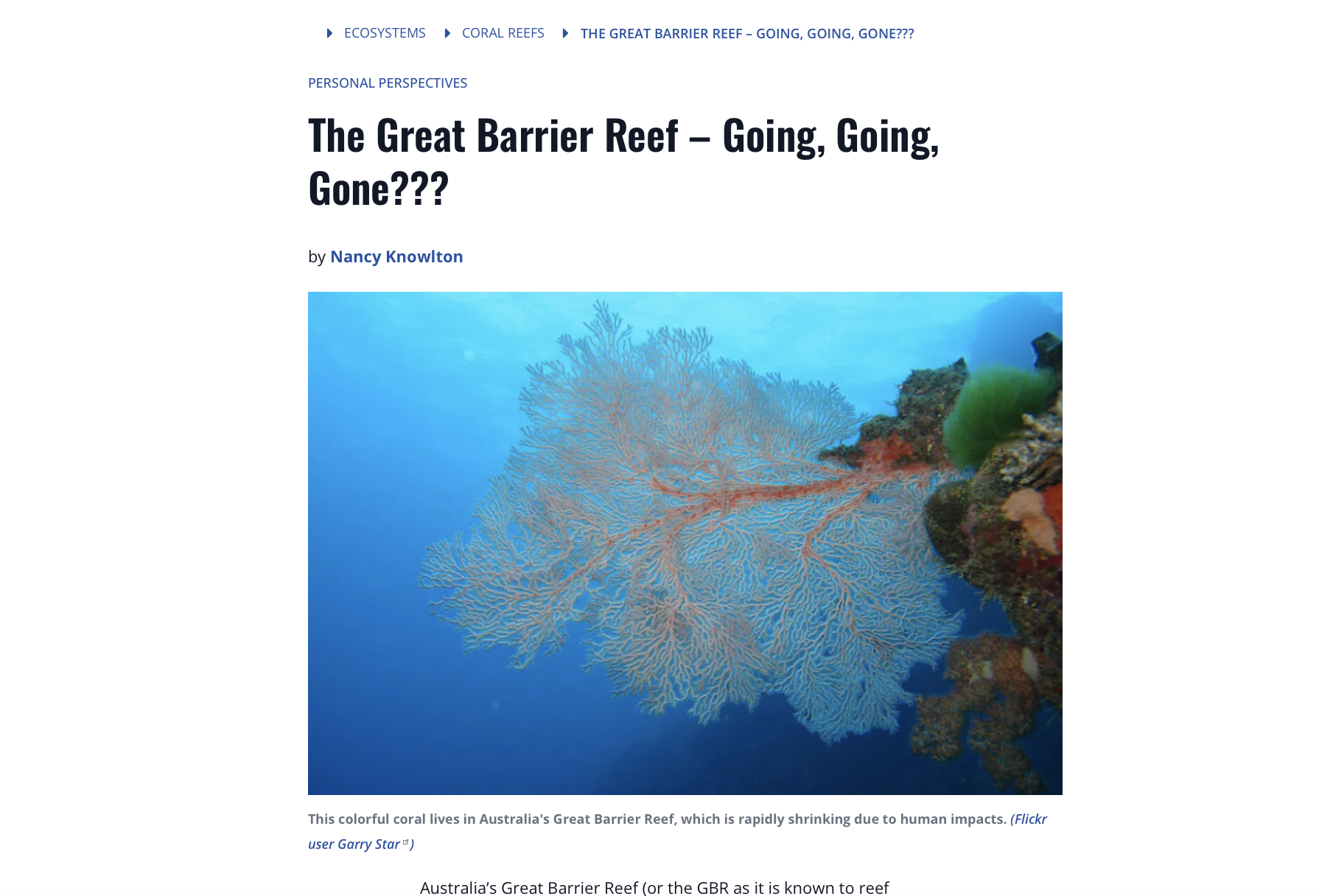
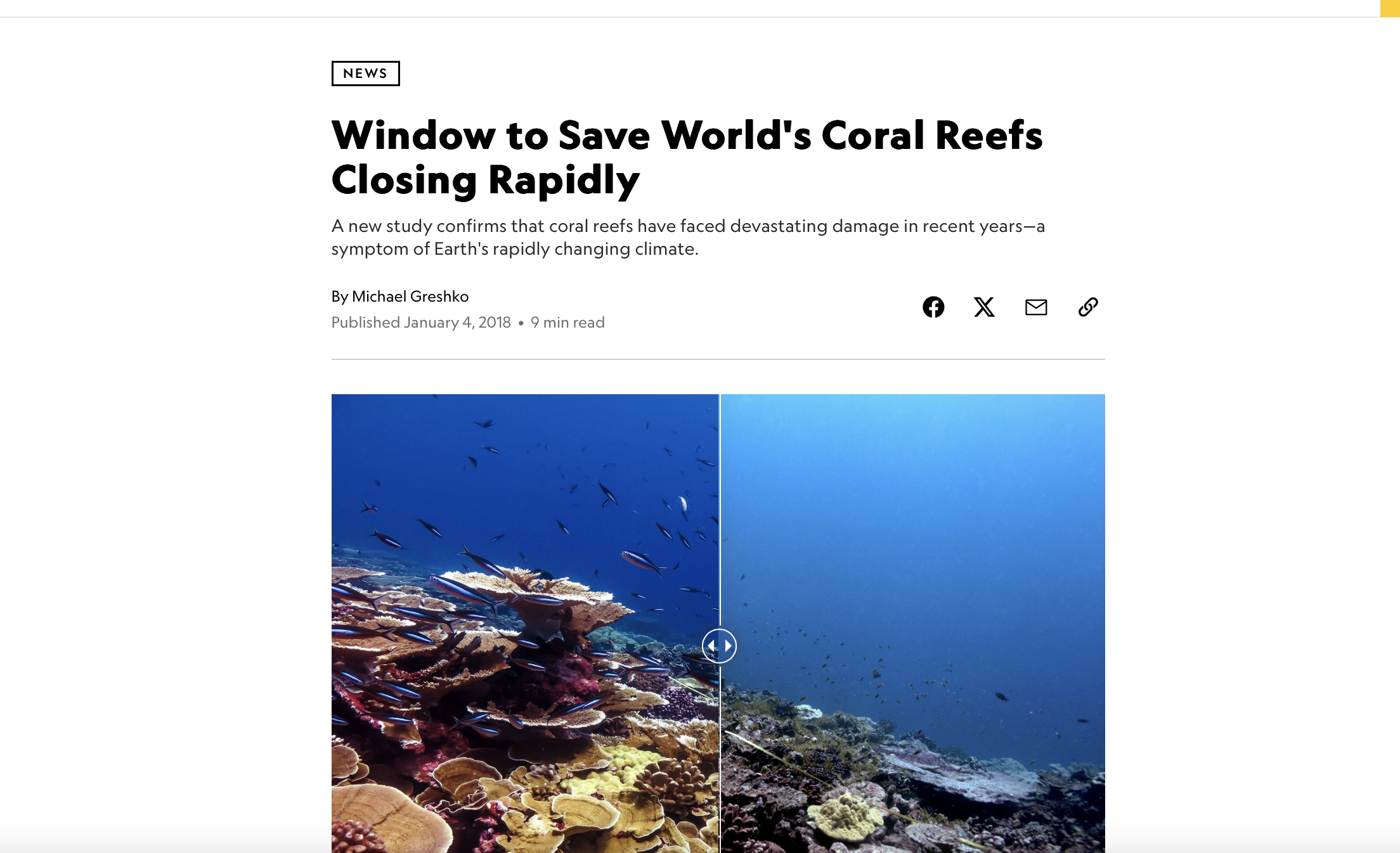
Numbers can feel abstract until you see the impact for yourself. These are photographs of real reefs before and after a single bleaching event and the headlines sounding the alarm worldwide.
What you can do
That's where the story leaves us, and where you come in. Here are some steps you can take to ease the stress on coral reefs.
- Eat sustainable seafood. Choosing sustainably caught fish helps keep marine food webs and protected habitats intact.
- Avoid polluting. Beyond recycling and reducing waste, limiting fertilizers and other pollutants keeps harmful runoff from reaching the coast.
- Volunteer and give. Beach and reef cleanups, donations, and local conservation groups are direct ways to protect the ecosystems near you.
- Tread lightly when you visit. If you visit a reef, don't touch the coral, and use sunscreen and products that are safe for marine life.